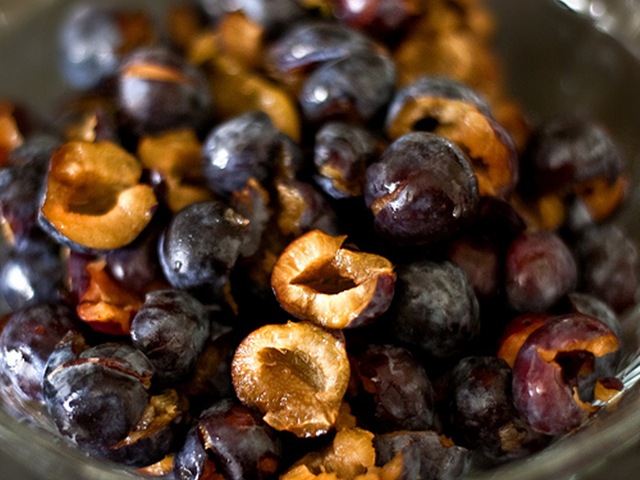
While recently searching for ways to use up the sack of damsons I was given by a friend, and tired of making chutney and jam, I re-discovered this amazingly easy-to-make but seriously tasty spread. I find Nutella much too rich and I've grown an aversion to vegetable oil in various products. This is less greasy (the only fat comes from the cocoa), and considerably less sweet. The damsons replace the greasiness of the nuts and oil with a more grown-up after-taste of fruity tartness, and the genuine taste of chocolate dominates and means that delicious as this is, you're not going to eat huge quantities of it before feeling sated.
There's a bit of political history attached to this recipe.
Back in the 1970s when Nutella hazelnut and chocolate spread was conquering the world and kids' palates, one part of the world it didn't reach was Eastern Europe.
While some rough chocolate did get through to that market, there were chronic shortages of almost all of the other ingredients, and of course of the branded product itself. However, those inventive and improvising Poles came up with a replacement for the hard-to-find nuts and sugar, and developed an alternative. it was never sold in shops and doesn't have a brand name, but most Polish families with children in 70s were aware of this.
I made this last week and as usual with my experiments took photos of the process but something went wrong and I've lost all the pics. I've managed to find some some replacements online which will have to do...
Ingredients:
2.5kg damsons, bullaces or plums, or combination thereof
1kg sugar (plus potentially another 500g for taste)
200g quality cocoa powder (or 300g high cocoa-solid [70%+] chocolate)
1 tablespoon vanilla extract (NOT "flavouring")
Optionally:
Handful of nuts of your choice
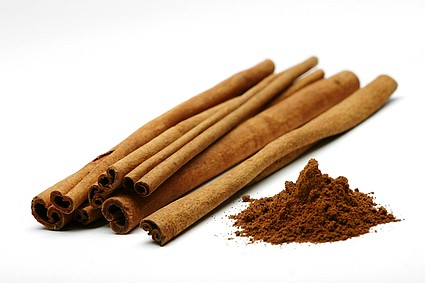
1 stick cinnamon or one teaspoon ground cinnamon
How to make it
First pit your damsons. this is going to take a long time, as the stones are proportionately quite large, and the flesh is usually fairly tightly stuck to them.
Put the damson flesh through a mincer, grinder or blender until finely puréed, together with chopped nuts (if used).
Empty the purée into a thick-bottomed 5-litre stainless steel saucepan.
Stir in 1kg sugar, mix well.
Add cinnamon stick or ground cinnamon, if using.
Put on low simmer, uncovered, stirring occasionally. Surprising as it may seem, this will not stick to the pan and can be left for extended periods without stirring. The stirring is just to keep the liqiuid and solids well mixed.
After 90 minutes, take out a spoonful of the mixture, allow to cool and taste for sweetness, tartness and texture. (Beware, the liquid out of the pot will be around boiling temperature!) Depending on the ripeness of your fruit and your own taste preference, stir in up to 500g more sugar.
Continue simmering for another 30 minutes if you did not add sugar, or 60 minutes if you did.
Add cocoa powder or chocolate broken into pieces, and stir well with a whisk until completel dissolved.
Stir in vanilla extract.
Continue simmering for another 10 minutes until the cocoa has cooked through and lost its raw bitterness.
In the meantime, wash, sterilise and dry six 500ml jars (see instructions provided in eafrlier blogs, or look them up online)
If desired, put mixture through blender/liquidiser again to make it super-smooth, return to pan and simmer for five minutes.
Pour into the sterilised jars, cover with cellophane circles and tighten covers.
Ready to eat immediately, warm or cold, as a spread on bread or cakes, as a filling for doughnuts or spooned on pancakes!
This spread does not want pasteurising/proofing (boiling would ruin the chocolate), and will keep for up to three months in a cool dark larder or cupboard. Once opened, store in fridge (unlike Nutella, which should never be refrigerated!) and use within two weeks.
Enjoy! I certainly do!
Sunday, 4 September 2011
It's been a while....
While preparing a new entry, I noticed that I've not written anything here for ages.
I've taken the opportunity to make a few changes, mainly to remove all the adult content and consequently the adult tag (I have tumblr for that).
I'll also make a couple of other changes in the near future, mainly changing the title of the blog, and devoting it more to cooking and preserving food though I hope to continue making odd comments on other subjects too.
Look out for a new recipe in the next few hours!
I've taken the opportunity to make a few changes, mainly to remove all the adult content and consequently the adult tag (I have tumblr for that).
I'll also make a couple of other changes in the near future, mainly changing the title of the blog, and devoting it more to cooking and preserving food though I hope to continue making odd comments on other subjects too.
Look out for a new recipe in the next few hours!
Friday, 8 July 2011
Oops
I just relised while reading a couple of other blogs that I've not written anything here since before Christmas.
It's probably time for a new cooking blog, and so I might throw something together in the next few days as I have a load of gooseberries and cherries to preserve.
Any ideas?
It's probably time for a new cooking blog, and so I might throw something together in the next few days as I have a load of gooseberries and cherries to preserve.
Any ideas?
Friday, 24 December 2010
Christmas Greetings - in Legalese
I've published these legalese and politically correct Christmas greetings once or twice before, but that's no reason not to share them here as well.
BE IT HEREBY DECLARED THAT
1. I would like you to accept with no obligation, implied or implicit, my best wishes for:
a) An environmentally conscious, socially responsible, low stress, non-addictive, gender neutral celebration of the winter solstice holiday practiced within the most enjoyable traditions of the religious or secular practices of your choice without prejudice to the religious and/or secular persuasions and/or traditions of others or their choice not to practice religious or secular traditions at all;
b) A fiscally successful, personally fulfilling and medically uncomplicated passing of the calendar year 2010CE, without prejudice to the calendars of other cultures whose contributions to society have helped make our (or your) country great without implying that our (or your) country is greater than any other country or is the only great country, and without regard to race, creed, colour, age, physical ability, religious faith (or lack thereof) or sexual orientation.
2. The wishes expressed in Part 1 are granted on the following terms:
a) they are to be considered extended to all members of your family or other social unit, including but not limited to:
i) other persons directly or indirectly related to you by blood or otherwise and any such persons to whom you consider yourself to be related regardless of biological, legal, religious or other process,
ii) any person or persons not included in paragraph 2a)i) hereof with whom you enjoy regular (or otherwise) consensual sexual activities regardless of gender, race, age or sexual orientation with or without the possibility for procreation,
iii) other animal and/or vegetable organisms (or inanimate objects) you or anyone else may consider part of your family or other social unit;
b) they are freely transferable with no alteration to the original wishes to any person in your wider social circle not included in paragraph 2a hereof;
c) they are limited to a period of one terrestrial solar year or until the issue of subsequent holiday wishes, whichever occurs first;
d) they are subject to clarification or withdrawal and are revocable at my sole discretion at any time, for any reason or for no reason at all;
e) no promise to implement any of the wishes or responsibility for the consequences which may arise from the implementation or non-implementation of same is or may be implied.
3. These wishes are void where prohibited by law and are specifically not extended to any extra-terrestrial or other beings who bear ill-will towards any or all members of the species known as Homo sapiens or any other life-form on planet Earth.
4. In accordance with environmental policies, procedures and practices, no trees were directly harmed in the preparation or transmission of these wishes although a significant number of electrons was slightly inconvenienced.
IN WITNESS WHEREOF I have hereunto applied my signature, seal or other personally identifiable mark this 24th day of December 2010CE
BE IT HEREBY DECLARED THAT
1. I would like you to accept with no obligation, implied or implicit, my best wishes for:
a) An environmentally conscious, socially responsible, low stress, non-addictive, gender neutral celebration of the winter solstice holiday practiced within the most enjoyable traditions of the religious or secular practices of your choice without prejudice to the religious and/or secular persuasions and/or traditions of others or their choice not to practice religious or secular traditions at all;
b) A fiscally successful, personally fulfilling and medically uncomplicated passing of the calendar year 2010CE, without prejudice to the calendars of other cultures whose contributions to society have helped make our (or your) country great without implying that our (or your) country is greater than any other country or is the only great country, and without regard to race, creed, colour, age, physical ability, religious faith (or lack thereof) or sexual orientation.
2. The wishes expressed in Part 1 are granted on the following terms:
a) they are to be considered extended to all members of your family or other social unit, including but not limited to:
i) other persons directly or indirectly related to you by blood or otherwise and any such persons to whom you consider yourself to be related regardless of biological, legal, religious or other process,
ii) any person or persons not included in paragraph 2a)i) hereof with whom you enjoy regular (or otherwise) consensual sexual activities regardless of gender, race, age or sexual orientation with or without the possibility for procreation,
iii) other animal and/or vegetable organisms (or inanimate objects) you or anyone else may consider part of your family or other social unit;
b) they are freely transferable with no alteration to the original wishes to any person in your wider social circle not included in paragraph 2a hereof;
c) they are limited to a period of one terrestrial solar year or until the issue of subsequent holiday wishes, whichever occurs first;
d) they are subject to clarification or withdrawal and are revocable at my sole discretion at any time, for any reason or for no reason at all;
e) no promise to implement any of the wishes or responsibility for the consequences which may arise from the implementation or non-implementation of same is or may be implied.
3. These wishes are void where prohibited by law and are specifically not extended to any extra-terrestrial or other beings who bear ill-will towards any or all members of the species known as Homo sapiens or any other life-form on planet Earth.
4. In accordance with environmental policies, procedures and practices, no trees were directly harmed in the preparation or transmission of these wishes although a significant number of electrons was slightly inconvenienced.
IN WITNESS WHEREOF I have hereunto applied my signature, seal or other personally identifiable mark this 24th day of December 2010CE
Friday, 5 November 2010
France or England? French or English?
I received an interesting question on formspring yesterday (yes, it does happen, not every question is about sexual habits), a full answer to which required a bit more space than is reasonable on formspring, so here it is. I've left the question verbatim.
To all intents and purposes, France is three different countries: there's Paris, there are other big cities, and there's rural France.
In that respect, England is not dissimilar, with London, other big cities and rural England presenting quite distinct characters.
I prefer to live in London rather than Paris (I've done both), but I prefer Paris to visit rather than London (I've done both). Paris is quite horrifyingly expensive (especially now, given the poor £/€ exchange rate) and the stereotype about Parisians being rude and aloof towards foreigners is generally a deserved one. They also consider themselves better than most Frenchmen, though, so there's no need to feel TOO aggrieved.
As a place to visit as a tourist, Paris is quite exceptional: it's small and compact, and all the famous sights are relatively close to each other (except perhaps for Versailles which is still a lot closer to Paris than, say, Windsor is to London). Public transport is a damn sight cheaper and easier to use. And there are always a million interesting things to see in countless small museums and galleries.
In London, everything is spread around and hard to get to. And it's all far more commercial, with all the sights selling the same tat just with different logos.
Large cities in France have a different attitude to those in England: Birmingham, Manchester, Liverpool and a few other places are resentful of London and want to be London. French cities know they aren't Paris and delight in their own identity, and are much more easy-going for it. I've spent time in Lyon, Toulouse, Bordeaux and a couple of other places, and they're much better than their English counterparts.
I adore rural France with a passion. French farmers have an odd reputation on this side of the Channel as intransigent, money grabbing xenophobes but they're really just trying to make a living. Of course they're often not very highly educated and rarely speak a foreign language so you're better of speaking French with them.
If you do take the trouble to converse in their language, you'll get an honest opinion about most things and they'll point you in the right direction to get the best produce and wine at the best price. And one real advantage of rural/small-town France over village life in England is that you can be accepted very quickly, if you take the trouble to integrate yourself and play a part in village life.
By contrast, small communities in England are famed for their reluctance to accept strangers. The owners of holiday homes in small villages who price the locals out of the property market and are hardly ever there are generally seeen as intruders and are not very welcome. Small-town French people feel honoured that people from outside their community pay an interest and are aware that thanks to new residents, local craftsmen and traders can earn an honest living. They are simply far more pragmatic.
Of course, any British tourist to small-town France will complain of the complete lack of any sense of punctuality, that arranging for a tradesperson to call "on Tuesday" actually means "any time between Monday morning and Friday night". And most places (even large ones) close down for several hours at lunchtime and it can be a right pain.
But it's a more relaxed and convivial mode of life which it's actually easy to get used to.
Village and rural politics are a nightmare in both cultures but the thing to remember in small-town France is that the Maire (mayor) is a truly important person. They are the foot of the pyramid of French democracy and of the national political system, and they can make life very easy for you, or - if you get on their bad side - very hard. The Mairie is the first stop for pretty much any administrative matter or local dispute. But not only - it is also your first port of call for things like utilities, so you make a personal enemy of the Maire and his staff at your peril. And in most small towns and villages the Mairie is also the post office, telephone exchange, police station and local information centre so knowing when it's staffed is a Very Important Piece Of Information.
On the subject of language, every language has its strong and weak points, its advantages and disadvantages.
English spelling is infamously horrendous, French is slightly lesss idiosyncratic but still full of potholes; English is good with expressing most technical things while French is generally more comfortable with matters of the intellect such as philosophy and the arts. (People say French is the language of love but I tend to disagree; Italian is MUCH better at it.)
The main strength of English is that whilst English grammar is a minefield and most native speakers know very few of the rules which govern our language, it is very easy to be perfectly comprehensible and relatively clear by stringing simple sentences together, as long you stick to a Subject - verb - object structure. Grammatical correspondence, pronunciation and very often spelling and punctuation are largely irrelevant.
In the musical My Fair Lady, Professor Higgins exclaims that the French never care what they do, as long as they pronounce it properly; this isn't entirely true - what's important is that the sentence is structured properly and the nouns and verbs correspond by gender and number, and the correct pronouns are used in the correct way to determine relationships. It's not fussiness or pedantry; the fact of the matter is that otherwise more than likely the sentence will literally make no sense.
So in short, I would say that the beauty of English (and probably one of the reasons for its popularity world-wide, it's not JUST because of the ubiquity of American culture and technology) is the fact that it is a very fluid language, in which it is extremely easy to make yourself understood. It is a very diffficult langauge to master because rules of correct syntax and grammar (if one wishes to be prescriptivist) are instinctive and intuitive rather than learnable by rote.
The beauty of French, on the other hand, lies in its precision and despite appearances, the sheer logic of it all. It is actually a fairly easy language to learn well out of a book of grammar, and speaking it idiomatically can be extremely difficult. Knowing which rules are relaxable and which are not takes much skill, experience and understanding.
I'd like to conclude by bringing together the language point and my love of rural France. It is almost impossible to understand a French farmer if you have learned your French at school from books.
There are so many regional variations where other influences from Spanish, Moorish, Italian, German, Flemish or various Old French varieties are so ingrained that you would need your interlocutor to speak slowly and repeat everything for you to understand him/her. Of course, they would understand you because the French media are Paris-centric and spoken in "proper French" to an even greater extent than English media are concerned with London.
Over the years, it's become normal in British television, for instance, to hear voices and accents from all over our country and we can all think of significant television presenters with a strong regional identity. This remains almost unheard of in French television - even though many presenters are proudly associated with wherever they may come from, they MUST speak the French equivalent of Received Pronunciation or they will simply never get a serious job in broadcasting. Some of them are famous for havig the odd foible, in the way they might pronounce a certain word or phrase, but by and large Parisian French is Comprehensible French.
I'd like to hear anyone's views on these topics, however well or badly informed, either in comments here (which can be a pain) or by way of a new question on formspring, which can be a lot easier (I do allow anonymous questions so you don't need an account or anything):
http://www.formspring.me/brumplum
To all intents and purposes, France is three different countries: there's Paris, there are other big cities, and there's rural France.
In that respect, England is not dissimilar, with London, other big cities and rural England presenting quite distinct characters.
I prefer to live in London rather than Paris (I've done both), but I prefer Paris to visit rather than London (I've done both). Paris is quite horrifyingly expensive (especially now, given the poor £/€ exchange rate) and the stereotype about Parisians being rude and aloof towards foreigners is generally a deserved one. They also consider themselves better than most Frenchmen, though, so there's no need to feel TOO aggrieved.
As a place to visit as a tourist, Paris is quite exceptional: it's small and compact, and all the famous sights are relatively close to each other (except perhaps for Versailles which is still a lot closer to Paris than, say, Windsor is to London). Public transport is a damn sight cheaper and easier to use. And there are always a million interesting things to see in countless small museums and galleries.
In London, everything is spread around and hard to get to. And it's all far more commercial, with all the sights selling the same tat just with different logos.
Large cities in France have a different attitude to those in England: Birmingham, Manchester, Liverpool and a few other places are resentful of London and want to be London. French cities know they aren't Paris and delight in their own identity, and are much more easy-going for it. I've spent time in Lyon, Toulouse, Bordeaux and a couple of other places, and they're much better than their English counterparts.
I adore rural France with a passion. French farmers have an odd reputation on this side of the Channel as intransigent, money grabbing xenophobes but they're really just trying to make a living. Of course they're often not very highly educated and rarely speak a foreign language so you're better of speaking French with them.
If you do take the trouble to converse in their language, you'll get an honest opinion about most things and they'll point you in the right direction to get the best produce and wine at the best price. And one real advantage of rural/small-town France over village life in England is that you can be accepted very quickly, if you take the trouble to integrate yourself and play a part in village life.
By contrast, small communities in England are famed for their reluctance to accept strangers. The owners of holiday homes in small villages who price the locals out of the property market and are hardly ever there are generally seeen as intruders and are not very welcome. Small-town French people feel honoured that people from outside their community pay an interest and are aware that thanks to new residents, local craftsmen and traders can earn an honest living. They are simply far more pragmatic.
Of course, any British tourist to small-town France will complain of the complete lack of any sense of punctuality, that arranging for a tradesperson to call "on Tuesday" actually means "any time between Monday morning and Friday night". And most places (even large ones) close down for several hours at lunchtime and it can be a right pain.
But it's a more relaxed and convivial mode of life which it's actually easy to get used to.
Village and rural politics are a nightmare in both cultures but the thing to remember in small-town France is that the Maire (mayor) is a truly important person. They are the foot of the pyramid of French democracy and of the national political system, and they can make life very easy for you, or - if you get on their bad side - very hard. The Mairie is the first stop for pretty much any administrative matter or local dispute. But not only - it is also your first port of call for things like utilities, so you make a personal enemy of the Maire and his staff at your peril. And in most small towns and villages the Mairie is also the post office, telephone exchange, police station and local information centre so knowing when it's staffed is a Very Important Piece Of Information.
On the subject of language, every language has its strong and weak points, its advantages and disadvantages.
English spelling is infamously horrendous, French is slightly lesss idiosyncratic but still full of potholes; English is good with expressing most technical things while French is generally more comfortable with matters of the intellect such as philosophy and the arts. (People say French is the language of love but I tend to disagree; Italian is MUCH better at it.)
The main strength of English is that whilst English grammar is a minefield and most native speakers know very few of the rules which govern our language, it is very easy to be perfectly comprehensible and relatively clear by stringing simple sentences together, as long you stick to a Subject - verb - object structure. Grammatical correspondence, pronunciation and very often spelling and punctuation are largely irrelevant.
In the musical My Fair Lady, Professor Higgins exclaims that the French never care what they do, as long as they pronounce it properly; this isn't entirely true - what's important is that the sentence is structured properly and the nouns and verbs correspond by gender and number, and the correct pronouns are used in the correct way to determine relationships. It's not fussiness or pedantry; the fact of the matter is that otherwise more than likely the sentence will literally make no sense.
So in short, I would say that the beauty of English (and probably one of the reasons for its popularity world-wide, it's not JUST because of the ubiquity of American culture and technology) is the fact that it is a very fluid language, in which it is extremely easy to make yourself understood. It is a very diffficult langauge to master because rules of correct syntax and grammar (if one wishes to be prescriptivist) are instinctive and intuitive rather than learnable by rote.
The beauty of French, on the other hand, lies in its precision and despite appearances, the sheer logic of it all. It is actually a fairly easy language to learn well out of a book of grammar, and speaking it idiomatically can be extremely difficult. Knowing which rules are relaxable and which are not takes much skill, experience and understanding.
I'd like to conclude by bringing together the language point and my love of rural France. It is almost impossible to understand a French farmer if you have learned your French at school from books.
There are so many regional variations where other influences from Spanish, Moorish, Italian, German, Flemish or various Old French varieties are so ingrained that you would need your interlocutor to speak slowly and repeat everything for you to understand him/her. Of course, they would understand you because the French media are Paris-centric and spoken in "proper French" to an even greater extent than English media are concerned with London.
Over the years, it's become normal in British television, for instance, to hear voices and accents from all over our country and we can all think of significant television presenters with a strong regional identity. This remains almost unheard of in French television - even though many presenters are proudly associated with wherever they may come from, they MUST speak the French equivalent of Received Pronunciation or they will simply never get a serious job in broadcasting. Some of them are famous for havig the odd foible, in the way they might pronounce a certain word or phrase, but by and large Parisian French is Comprehensible French.
I'd like to hear anyone's views on these topics, however well or badly informed, either in comments here (which can be a pain) or by way of a new question on formspring, which can be a lot easier (I do allow anonymous questions so you don't need an account or anything):
http://www.formspring.me/brumplum
Wednesday, 3 November 2010
Am I really THAT unlikable?
Despite appearances, this isn't just wallowing in self-pity, and the questions aren't rhetorical. I am genuinely at an impasse in how I perceive myself.
When I was younger, I honestly didn't care about being the terminally-uncool fat friendless dweeb in the corner unliked by many but simply unnoticed by most. With my books and the few even dweebier friends I had, I escaped into fantasy.
Despite the hopeful image of countless books, films and TV shows (and indeed the biography of certain captains of industry in the real world), I didn't end up rich and powerful and manage to gloat at those who refused to give me the time of day when we were younger.
No, now as I approach (!) middle age, I grow increasingly resentful of those living happy lives in the full and certain knowledge that the fact I try to be nice counts for nothing.
Three friends, each of whom individually claims to like me as a friend and is happy to call on me for favours, arrange to go out together. I am pointedly (and, as far as I can tell, deliberately) not invited. They don't hide their plans, I drop hints about my interest in attending, which are ignored.
What should I conclude?
That I am unworthy of their company?
That their friendship is just a front, that they're happy to take what I can give but offer nothing in return?
That while each of them might be happy to be in my company, they're unhappy to be seen to be in my company?
All my life I've been happy to be "used" by those around me - I derive genuine pleasure from helping others.
Is it unreasonable to expect appreciation?
What's to stop me giving in to the urge to climb the top of the nearest tall building, shouting to all the world,
NO IT DOES NOT GET ANY FUCKING BETTER
and then throwing myself into the abyss?
(P.S. I'm not actually suicidal)
When I was younger, I honestly didn't care about being the terminally-uncool fat friendless dweeb in the corner unliked by many but simply unnoticed by most. With my books and the few even dweebier friends I had, I escaped into fantasy.
Despite the hopeful image of countless books, films and TV shows (and indeed the biography of certain captains of industry in the real world), I didn't end up rich and powerful and manage to gloat at those who refused to give me the time of day when we were younger.
No, now as I approach (!) middle age, I grow increasingly resentful of those living happy lives in the full and certain knowledge that the fact I try to be nice counts for nothing.
Three friends, each of whom individually claims to like me as a friend and is happy to call on me for favours, arrange to go out together. I am pointedly (and, as far as I can tell, deliberately) not invited. They don't hide their plans, I drop hints about my interest in attending, which are ignored.
What should I conclude?
That I am unworthy of their company?
That their friendship is just a front, that they're happy to take what I can give but offer nothing in return?
That while each of them might be happy to be in my company, they're unhappy to be seen to be in my company?
All my life I've been happy to be "used" by those around me - I derive genuine pleasure from helping others.
Is it unreasonable to expect appreciation?
What's to stop me giving in to the urge to climb the top of the nearest tall building, shouting to all the world,
NO IT DOES NOT GET ANY FUCKING BETTER
and then throwing myself into the abyss?
(P.S. I'm not actually suicidal)
Sunday, 17 October 2010
When can we get a Marmite 'n' anything stand?
For convoluted reasons I don't feel like explaining right now, Nutella and Marmite are closely associated in my psyche (suffice to say, their main roile is to be spread on bread and some people like them, and some don't).
I found this rather magnificent picture of a Nutelleria stand in Italy which sells all kinds of things spread with Nutella:

When can we get something similar but with Marmite, not a Nutelleria but a Marmitery?
I found this rather magnificent picture of a Nutelleria stand in Italy which sells all kinds of things spread with Nutella:

When can we get something similar but with Marmite, not a Nutelleria but a Marmitery?
Subscribe to:
Posts (Atom)